One
of humanity’s most valuable resources for exploring the universe is space-based
telescopes. Perhaps the most famous of these telescopes is Hubble, which has
had an impressive 29-year career. With time comes age, however, and there now
exist improved pieces of technology that compete with Hubble. As a result,
plans for the James Webb Space Telescope, a next-generation space observatory,
were created. Originally it had a planned launch date of 2011, however, billions
of dollars over funding and eight years later, JWST still has not launched.
This date is now firmly on the horizon because for the first time, its two
halves were joined together by NASA engineers.
JWST
is composed of two main parts: the telescope itself, the iconic golden mirror
made of 18 hexagons, and the spacecraft itself, equipped with a sunshield to
protect the telescope’s scientific instruments from harmful solar radiation.
Until now, these two parts have been separated. Each piece has undergone several
brutal tests, designed to simulate both the ascent to space on a rocket and
placement in space. However, they have not yet been tested together; now, this
is possible.
This
assembly is a major milestone in the project’s history. The telescope has
survived cancellation attempts and waves of criticism after successive launch
dates have not been met. Thankfully, this indicates that the end is near, with
a current projected launch date of March 30, 2021.
JWST
will play a crucial role in observational astrophysics for the coming decades
of the 21st century. As the successor to Hubble, it will provide us
with an even better ability to observe the universe. Compared to the Hubble, it
has significantly increased resolution and sensitivity, allowing for
never-before-seen images of the cosmos to be captured. Observing primarily in
the infrared spectrum the James Webb Space Telescope will allow scientists
around the world to explore some of the most fundamental mysteries in astronomy
and cosmology. It will be able to see farther back into the history of the
universe than ever before, perhaps even observing the first galaxies to have
ever formed.
On July 16, 1969, three men left
Earth inside the most powerful rocket ever created. After a four-day journey,
50 years ago today, two of those men set foot on the Moon. In terms of
distance, bravery, and impact on our species, Apollo 11 is perhaps the greatest
mission to ever have been undertaken. Its effects are still felt today, and
will continue to be felt far into the future.
Apollo 11 served as a brief glimpse
into what our future may be. It showed us that not only can we travel to space,
but we can establish ourselves on other worlds; our future is in space and is
driven by science. Apollo 11 inspired millions of scientific minds at the time,
and will continue to inspire millions more.
More importantly, it showed us that
we can set aside our differences and unite as a species. In the depths of the
Cold War, with nuclear annihilation seemingly imminent, the world every so
fleetingly united to see the first man to walk on the Moon. From space, borders
do not exist; we are one people with the Earth as our nation.
Apollo 11 conveyed a message of hope
and excitement to the world. This excitement set in motion an urge to continue
exploring, to continue pushing our boundaries beyond Earth. Apollo 11
encouraged many to dream of setting foot on another world, and these dreams
will be realized for some. The drive to return to the Moon will soon culminate
in missions such as NASA’s Artemis mission, and plans SpaceX has for a Moon
base. This time, we are going to the Moon to stay. The drive to continue
advancing the frontier has led to monumental innovations and inventions, which
will take us not only to the Moon again but beyond. This drive will take us to
Mars, and to the outer solar system, and one day to other stars entirely. The
Moon landing ignited a flame which will fuel our journeys for years to come.
Neil Armstrong’s small step was our
first step as a species outside of our cradle, venturing into another world.
This small step was our first step on our way to becoming a spacefaring
species. The repercussions of this step will be felt far in the future, and the
words accompanying this step will be etched in the memory of humanity for
eternity. The first words spoken on the Moon will forever echo on Earth.
The 50th anniversary of the
Moon landing allows us to reflect upon our past, and start working for the
future. Since the Moon landing, we have made great strides in fields all across
STEM, and the world is a better place for it. However, we have also come closer
and closer to destroying ourselves and taking the Earth with us through climate
change and our inability to stop fighting. Let this day remind us what we are
capable of, and what our future can be. There is a bright future for humanity
out among the stars, and it is our job to work for it.
Apollo was our first step into the
beyond. It will not be our last.
Everyone knows that Elon Musk’s projects revolutionize their industries and catalyze humanity’s progress - and his new proposal is not an odd one out. Starlink, the satellite constellation, would be a giant collective of 12,000 satellites orbiting the Earth and providing high-speed internet to even the most remote locations on the planet. As of May 23, 2019 SpaceX has launched 60 satellites for testing purposes on their Falcon 9 rocket. Currently, Starlink is projected to begin officially operating in 2021. However, the question remains: How can the high volume of devices be sent into space and is the task even possible?
First, let’s take a closer look at the financial considerations of this project. Each satellite weighs around 250 kilograms. Considering $20,000 is the approximate price of sending 1kg on orbit on the Atlas V type rocket, it would cost NASA 60 BILLION dollars just in transportation costs to implement Starlink. Nevertheless, Elon Musk has an answer for this problem. With the SpaceX’s Falcon Heavy rocket, which uses a reusable booster system, the price of launching 1kg to space drops to $1,700. This then drives the cost to launch all the 12,000 Starlink satellites to 5.1 billion dollars instead.
At this point, many of you might ask why it’s necessary to have this myriad of satellites hovering over the Earth? The answer becomes clear when taking the developing countries into account. According to Internet World Stats, only 38% of the population in Africa has access to the internet compared to 90% in North America. By introducing the Internet to these individuals, they would then be able to utilize the nearly bottomless pool of educational and academic resources. The poor access to the internet drives the Human Development Index to the low end and creates a loss in human capital. Currently, the price of internet in Africa is roughly $35 per gigabyte. This makes it almost impossible for the general population in these countries to afford the Internet, as the average daily income is only $6. The Starlink project would drive down this price. It would allow villages to purchase a $200 receiver and then individuals would be able to pay a severely reduced fee to obtain access the internet.
Now the last question remains: But how would Elon Musk benefit from the project? Well, the answer is quite clear; it’s through the revenue generated from Starlink. Musk predicts this project has the potential to bring in $30 billion dollars by 2025. This would provide additional funding for the other SpaceX projects, including the human mission to Mars.
So is the Starlink project something out of a sci-fi book? The short answer is no. We currently possess the technology to implement a project of such scale for a relatively low price. However the fact that this project works on paper doesn’t mean that it would translate smoothly in the real world. There remain many unknown factors that will only come to light after the start of such a grandiose plan.
A
group of undergraduates from the University of Southern California
(USC) have announced the launch of what is likely the first-ever student
designed and built rocket to pass the Kármán line into outer space.
Internal
analysis of the system of the student's rocket Traveler IV shows that
the vehicle reached an altitude of 340,000 feet with a margin of error
of +/- 16,800 feet.
“We can say with 90 percent certainty that RPL’s latest spaceshot,
Traveler IV, passed the Kármán line, the recognized boundary between the
Earth’s atmosphere and space,” said Neil Tewskbury, lead operations
officer at RPL.
The students launched their rocket on April 21
at 7:30 AM local time from New Mexico's Spaceport America reaching a top
speed of 3,386 mph (5,449 km/hr). Traveler IV rapidly accelerated at
over 17g's over the course of its 11.5 second motor burn, then cruised
the remaining 140 seconds before reaching its maximum altitude.
RPL's
avionics system is custom-designed and built by RPL's team of over 80
undergraduates. This system allowed for the recording of the flight
using its onboard sensors and the deployment of the vehicle's parachutes
at apogee.
Looking forward, RPL has set its sights on its
next mission: a liquid-fuelled rocket that will shatter its own
respective world record. In addition, conceptual work has begun on
ambitious projects such as CubeSat deployment, active rocket
stabilization and new solid engine designs.
Read more about this story at the following links:
Early
morning on Saturday, a SpaceX Falcon 9 lifted off with an unmanned crew
capsule for the International Space Station (ISS). This is a key
milestone to demonstrate the company's capabilities to safely transport
astronauts as part of NASA's Commercial Crew Program.
The
4.9-metre-tall (16 foot) Crew Dragon capsule lifted off from Florida's
Kennedy Space Centre at 2:49 a.m. EST carrying supplies, equipment and a
test dummy nicknamed Ripley.
During its five-day stay aboard
the ISS, U.S. astronaut Anne McClan and Canadian astronaut David
Saint-Jacques will run tests to determine the condition of the Crew
Dragon's cabin.
“I almost thought we would fail. I thought maybe we’d have a 10
percent chance of reaching orbit starting out,” Elon Musk said of his feelings when he founded the space company
in 2002.
“I’m a little emotionally exhausted because that was
super stressful, but it worked,” he told reporters after Saturday’s
launch.
Scientists
have released a new image sequence from NASA's New Horizons spacecraft
offering a farewell glance of the Kuiper Belt object known as Ultima
Thule. Although they are not the final images of the object to be sent
back from the spacecraft, these photos are in fact the final images
taken before New Horizons zipped past its flyby.
In the
newly released images, scientists made an exciting discovery - Ultima
Thule's shape. When first imaged, scientists and the public alike saw
that
Ultima Thule consisted of two distinct and spherical segments. Further
analysis of the approach and departure images revealed that the asteroid
is made of two distinct shape. The larger lobe, nicknamed "Ultima"
resembles the shape of a giant pancake while the smaller lobe, "Thule",
is shaped more like a dented walnut.
“We had an impression of Ultima Thule based on the limited number of
images returned in the days around the flyby, but seeing more data has
significantly changed our view,” said Alan Stern, mission Principal
Investigator at Southwest Research Insittute. “It would be closer to
reality to say Ultima Thule’s shape is flatter, like a pancake. But more
importantly, the new images are creating scientific puzzles about how
such an object could even be formed. We’ve never seen something like
this orbiting the Sun.”
“While the very nature of a fast flyby in some ways limits how well we
can determine the true shape of Ultima Thule, the new results clearly
show that Ultima and Thule are much flatter than originally believed,
and much flatter than expected,” added Hal Weaver, New Horizons project
scientist from the Johns Hopkins Applied Physics Laboratory. “This will
undoubtedly motivate new theories of planetesimal formation in the early
solar system.”
The
Chinese government has recently released a new photo giving viewers a
rare look at the far-side of the moon with Earth visible at the bottom
right.
The image was captured by a camera aboard the Chinese
DSLWP-B/Longjiang-2 satellite on February 4. The photo was downloaded at
the slow speed of less than one kilobyte per minute through the Dutch
Dwingeloo Radio Telescope.
"Downloading these 16 kilobytes took almost 20 minutes. We did
color-correct the original," said one of the telescope operators, Tammo Jan
Dijkema, on Twitter.
China made history last month when the
Chang'e 4 lunar rover touched down on the far side of the moon. Since
then, the rover has been giving scientists an unprecedented close look
at the mysterious and seldom-seen part of our lunar neighbour. The
mission objective is to document the far side of the moon and study the
geology near the landing site.
On New Year’s Day, NASA’s New Horizons spacecraft famous for its Pluto flyby in 2015 flew by the farthest-ever reached object by humankind. Now after a few days, NASA is receiving the first data from this historic flyby of Ultima Thule, also known as Kuiper belt object 2014 MU69.
Amongst the things received from New Horizons is the first resolved photos of Ultima Thule. These images reveal a 33 kilometre (21 mile-long) “contact binary” body composed of two roughly spherical lobes. These lobes are red and their icy surface is likely discoloured by deep-space radiation. The process that created this colour is likely responsible for the similar reddish hue visible on Pluto’s surface and the northern parts of its largest moon Charon.
Ultima Thule is a remnant of the early solar system. Countless objects similar to Ultima Thule coalesced to form the solar system’s planets. However this did not happen to Ultima Thule, which has stayed in pristine condition for eons in the cold Kuiper Belt.
"We think what we're looking at it is perhaps the most primitive object that has yet been seen by any spacecraft, and may represent a class of objects which are the oldest and most primitive objects that can be seen anywhere in the present solar system," said Jeff Moore from NASA’s Ames Research Center during a New Years Day news conference.
Newly
analyzed data from NASA's Origins, Spectral Interpretation, Resource
Identification, Security-Regolith Explorer (OSIRIS-REx) has revealed the
presence of water locked within the clays of the asteroid Bennu.
Since
the beginning of the mission's approach phase in mid-August, the
science team has been using three instruments on the spacecraft to begin
making preliminary scientific observations of the asteroid from afar.
Data
obtained from the spacecraft's two spectrometers revealed the presence
of molecules that contain oxygen and hydrogen atoms bonded together,
known as 'hydroxyls'. It is currently hypothesized that these hydroxyl
groups exist throughout the asteroid in water-bearing clay minerals.
This indicates that that at some point in its history, Benu's rocky
material interacted with water.
“The presence of hydrated minerals across the asteroid confirms that
Bennu, a remnant from early in the formation of the solar system, is an
excellent specimen for the OSIRIS-REx mission to study the composition
of primitive volatiles and organics,” said Amy Simon, OVIRS deputy
instrument scientist at NASA’s Goddard Space Flight Center in Greenbelt,
Maryland. “When samples of this material are returned by the mission to
Earth in 2023, scientists will receive a treasure trove of new
information about the history and evolution of our solar system.”
In a news
conference yesterday, NASA announced that its Voyager 2 probe exited the
heliosphere - the protective bubble composed of particles from the
solar wind created by our Sun. This marks the second time in history in
which a human-made object has left the near solar system.
Comparing
data gathered using different instruments on the spacecraft, scientists
realized that the probe crossed the boundary on November 5. Although
Voyager 1 made this crossing six years ago, Voyager 2 will be able to
provide unique observations through its still-functioning array of
instruments unlike its predecessor.
Scientists realized that
the spacecraft left the solar system when Voyager 2's Plasma Science
Experiment (PLS) observed a steep decline in the speed of the solar wind
particles on Nov. 5. Since that time, this instrument has detected
virtually no solar wind flow in its environment around Voyager.
"Working
on Voyager makes me feel like an explorer, because everything we're seeing is
new," said John Richardson, principal investigator for the PLS instrument and a
principal research scientist at the Massachusetts Institute of Technology in
Cambridge. "Even though Voyager 1 crossed the heliopause in 2012, it did so at
a different place and a different time, and without the PLS data. So we're
still seeing things that no one has seen before."
Although
both probes have crossed the heliosphere, these two spacecraft have not
left the solar system entirely. The boundary of the solar system is
considered to be beyond the outer edge of the Oort Cloud. The distance
of this collection of small objects under the gravity of the Sun is
currently known, but it is estimated that it may begin 1,000
astronomical units (AU) from the Sun and extend to over 100,000 AU.
At about 2:23 A.M. local time on Saturday, China launched a rocket
carrying the Chang'e-4 lunar lander from Xichang Satellite Launch Centre
in southern China. An unofficial live stream record near the site documented the rising of the rocket as it made its journey to the Moon.
Chang'e-4
contains a 2,400 pound lander and 300-pound rover based mainly on the
preexisting Chinese moon lander Chang'e-3 that touched down in 2013.
This
rover is set to land in the 110-mile-wide Von Kármán crater located on
the far side of the moon.This crater is found in the South Pole-Aitken
basin, a gigantic, 1,600-mile-wide crater near the bottom of the moon.
Through
a collaboration with entities such as Kiel University in Germany and
the Swedish Institute of Space Physics, the instruments will investigate
the structure of the rocks in the area to study the effects of the
solar wind on the lunar surface.
In addition, Chang'e-4 will
also make radio astronomy observations from the far side of the moon to
understand the lack of effects of noise and interference which are
present on Earth. This will be paired with a biological payload that
will see if plants seeds are capable of germinating and silkworm eggs
are able to hatch in the moon's low gravity.
Although China's
space agency has not announced a landing date, it is currently believed
by some experts that the lander will touch down around the first week of January.
In
documents recently acquired by news agency New Scientist and reported
by Gizmodo, NASA will be working with billionaire entrepreneur and
physicist Yuri Milner to launch the first ever private deep-space
mission. This project will look for life, if it exists, on Saturn's moon
Enceladus.
According to the documents, NASA and Milner's
non-profit Breakthrough Starshot Foundation will be working on
scientific, technical and financial plans for this mission. NASA has
committed over $70,000 to produce a concept study for the flyby mission.
This money won't be paid to Breakthrough but represents the agency's
staffing costs for the project. Breakthrough Initiatives would lead and
pay for an Enceladus fly-by mission, with consulting from NASA.
Icy
moons throughout the Jupiter and Saturn moon systems are thought of as
potential candidates for alien life. Jupiter's moon Europa has evidence
of water in the form of plumes spewing water vapour out of the cracks on
its surface.
Similarly, Enceladus has evidence of a warm
ocean and even complex organic molecules. All of this data was obtained
during the Cassini Space mission funded by NASA and ESA. Even though it
orbits Saturn which is even farther from Earth and Jupiter, life may
have evolved deep within the moon around heat emanating from volcanic
vents.
NASA
has recently authorized the implementation and 2021 launch of the Lucy
spacecraft. This will be the first mission that will visit the Trojans, a
population of primitive asteroids orbiting in tandem with Jupiter near
the asteroid belt.
The confirmation review authorized
continuation of the project into the development phase. The review panel
approved the detailed plans, instrument suite, budget and risk factor
analysis for the spacecraft. From here on in, the Critical Design Review
will examine Lucy's system design before assembly occurs.
“Up until now this mission has entirely been on paper,” said Lucy
Principal Investigator Hal Levison of the Southwest Research Institute
at Boulder, Colorado. “Now we have the go ahead to actually cut metal
and start putting this spacecraft together.”
During
its 12-year journey, the spacecraft is expected to visit seven
different asteroids - a Main Belt asteroid and six Trojans. Using a
remote-sensing instrument suite, the spacecraft will study the geology,
surface composition and bulk physical properties of these bodies at a
short range.
“Today’s confirmation of Lucy is a key step towards better understanding
the role that small bodies played in the formation of the Solar System
and life on Earth,” said Adriana Ocampo, Lucy’s program executive at
NASA Headquarters in Washington, DC. “We congratulate the entire team
for their hard work.”
NASA
officials announced on October 30 that the Kepler space telescope has
run out of fuel and will be decommissioned in the coming weeks. This
marks a lasting legacy that is responsible for 70 percent of the roughly
3,800 confirmed exoplanets discoveries to date.
Unlike NASA's
Cassini spacecraft which was deorbited into Saturn's thick atmosphere
in September 2017, Kepler will receive a much simpler end. Team members
will beam a single, simple command to the spacecraft, triggering a
decommissioning sequence. This will shut down its radio transmitter and
onboard fault-protection systems, converting the telescope into an inert
chunk of floating metal.
"Kepler is currently trailing the Earth by about 94 million miles, and
will remain the same distance from the Earth for the foreseeable
future," Charlie Sobeck, project system engineer at NASA's Ames Research
Center in Moffett Field, California, said during a teleconference with
reporters.
Kepler was launched back in March 2009, with its mission to determine the frequency of Earth-like plants around the Milky Way galaxy. Its first mission was initially composed of observing close to 150,000 stars simultaneously. Eventually this mission ended in May 2013 when the spacecraft lost the second its four orientation-maintainng reaction wheels. However after some remote modifications, a new mission was launched in 2014 as K2. that hauled in an additional 34 exoplanet finds.
According to new research from scientists at the NASA Ames Research Centre, spikes of ice known as penitentes
may tower
above the surface of Jupiter's moon Europa. Famous in the media in
recent years for its suspected subsurface saltwater ocean, this is a
prime location in the solar system for the search for extraterrestrial
life.
In the paper, scientists looked at the sublimation rates
of water ice across Europa's surface. By factoring other events that
might erode the icy moon's surface, such as asteroid impacts or
electrically charged particles hitting the moon from Jupiter, it was
found that this model would create a rough surface on Europa. In the
equatorial area of the moon, they found that sublimation would be
dominant enough to sculpt penitentes up to about 15 metres high and 7
metres across over a span of 50 million years (about the age of
Europea's surface)
These hypothesized areas of jagged ice
towers might pose a hazard for any future missions to Europa including
NASA's Europa lander concept. This will make reconnaissance key prior to deployal of any probes from orbit.
However it is just as possible that the penitente model may not apply to Europa. As it was based on penitente formation on Earth, some factors including a lack of atmosphere and Earth ices containing salts and sulfurous compounds could play a role in affecting this model.
"It is always pleasant to see how rigorous science can help us imagine
how the surface of an unknown planet could be at a scale never observed
yet," said planetary scientist Cyril Grima at the University of Texas at
Austin, who did not take part in this research.
Popular science fiction of the early 20th century depicted Venus as some kind of wonderland of pleasantly warm temperatures, forests, swamps and even dinosaurs. In 1950, the Hayden Planetarium at the American Natural History Museum were soliciting reservations for the first space tourism mission, well before the modern era of Blue Origins, SpaceX and Virgin Galactic. All you had to do was supply your address and tick the box for your preferred destination, which included Venus.
Today, Venus is unlikely to be a dream destination for aspiring space tourists. As revealed by numerous missions in the last few decades, rather than being a paradise, the planet is a hellish world of infernal temperatures, a corrosive toxic atmosphere and crushing pressures at the surface. Despite this, NASA is currently working on a conceptual manned mission to Venus, named the High Altitude Venus Operational Concept – (HAVOC).
But how is such a mission even possible? Temperatures on the planet’s surface (about 460°C) are in fact hotter than Mercury, even though Venus is roughly double the distance from the sun. This is higher than the melting point of many metals including bismuth and lead, which may even fall as “snow” onto the higher mountain peaks. The surface is a barren rocky landscape consisting of vast plains of basaltic rock dotted with volcanic features, and several continent-scale mountainous regions.
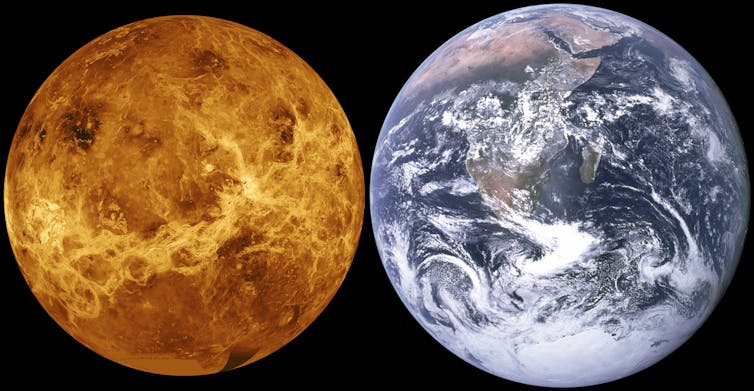
Venus was once an Earth twin.NASA / JPL
It is also geologically young, having undergone catastrophic resurfacing events. Such extreme events are caused by the build up of heat below the surface, eventually causing it to melt, release heat and re-solidify. Certainly a scary prospect for any visitors.
Hovering in the atmosphere
Luckily, the idea behind NASA’s new mission is not to land people on the inhospitable surface, but to use the dense atmosphere as a base for exploration. No actual date for a HAVOC type mission has been publicly announced yet. This mission is a long term plan and will rely on small test missions to be successful first. Such a mission is actually possible, right now, with current technology. The plan is to use airships which can stay aloft in the upper atmosphere for extended periods of time.
As surprising as it may seem, the upper atmosphere of Venus is the most Earth-like location in the solar system. Between altitudes of 50km and 60km, the pressure and temperature can be compared to regions of the Earth’s lower atmosphere. The atmospheric pressure in the Venusian atmosphere at 55km is about half that of the pressure at sea level on Earth. In fact you would be fine without a pressure suit, as this is roughly equivalent to the air pressure you would encounter at the summit of Mount Kilimanjaro. Nor would you need to insulate yourself as the temperature here ranges between 20°C and 30°C.
The atmosphere above this altitude is also dense enough to protect astronauts from ionising radiation from space. The closer proximity of the sun provides an even greater abundance of available solar radiation than on Earth, which can be used to generate power (approximately 1.4 times greater).
The conceptual airship would float around the planet, being blown by the wind. It could, usefully, be filled with a breathable gas mixture such as oxygen and nitrogen, providing buoyancy. This is possible because breathable air is less dense than the Venusian atmosphere and, as result, would be a lifting gas.
The Venusian atmosphere is comprised of 97% carbon dioxide, about 3% nitrogen and trace amounts of other gases. It famously contains a sprinkling of sulphuric acid which forms dense clouds and is a major contributor to its visible brightness when viewed from Earth. In fact the planet reflects some 75% of the light that falls onto it from the sun. This highly reflective cloud layer exists between 45km and 65km, with a haze of sulphuric acid droplets underneath down to about 30km. As such, an airship design would need to be resistant to the corrosive effect of this acid.
Luckily we already have the technology required to overcome the problem of acidity. Several commercially available materials, including teflon and a number of plastics, have a high acidic resistance and could be used for the outer envelope of the airship. Considering all these factors, conceivably you could go for a walk on a platform outside the airship, carrying only your air supply and wearing a chemical hazard suit.
Life on Venus?
The surface of Venus has been mapped from orbit by radar on the US Magellan mission. However, only a few locations on the surface have ever been visited, by the series of Venera missions of Soviet probes in the late 1970s. These probes returned the first – and so far only – images of the Venusian surface. Certainly surface conditions seem utterly inhospitable to any kind of life.
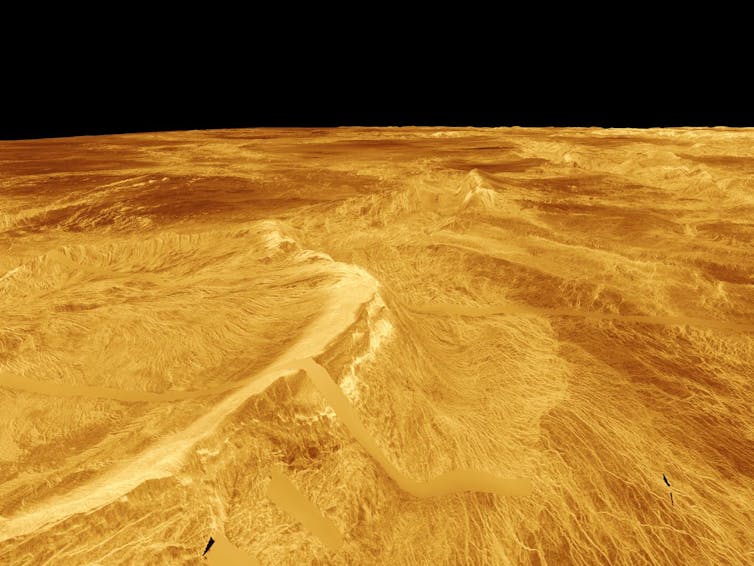
Venus as seen by Magellan.NASA
The upper atmosphere is a different story however. Certain kinds of extremophile organisms already exist on Earth which could withstand the conditions in the atmosphere at the altitude at which HAVOC would fly. Species such as Acidianus infernus can be found in highly acidic volcanic lakes in Iceland and Italy. Airborne microbes have also been found to exist in Earth’s clouds. None of this proves that life exists in the Venusian atmosphere, but it is a possibility that could be investigated by a mission like HAVOC.
The current climatic conditions and composition of the atmosphere are the result of a runaway greenhouse effect (an extreme greenhouse effect that cannot be reversed), which transformed the planet from a hospitable Earth-like “twin” world in its early history. While we do not currently expect Earth to undergo a similarly extreme scenario, it does demonstrate that dramatic changes to a planetary climate can happen when certain physical conditions arise.
By testing our current climate models using the extremes seen on Venus we can more accurately determine how various climate forcing effects can lead to dramatic changes. Venus therefore provides us with a means to test the extremes of our current climate modelling, with all the inherent implications for the ecological health of our own planet.
We still know relatively little about Venus, despite it being our nearest planetary neighbour. Ultimately, learning how two very similar planets can have such different pasts will help us understand the evolution of the solar system and perhaps even that of other star systems. Gareth Dorrian, Post Doctoral Research Associate in Space Science, Nottingham Trent University and Ian Whittaker, Lecturer, Nottingham Trent University
Aerospace
giant Lockheed Martin has released its latest proposal for a "crewed
lunar lander" and it is quite ambitious in terms of industry standards.
With the Trump administration's principal human spaceflight goal for the
near-term being the moon, NASA has begun accepting pitch ideas from
companies on how this could be accomplished.
As the company building the Orion spacecraft for NASA to carry its
astronauts into deep space, Lockheed Martin decided to weigh in with its
expertise in space transportation.
The lander would incorporate many aspects of the existing Orion design.
Measuring at 14 metres, the single-stage spacecraft can carry up to four
astronauts to the lunar surface for up to 14 days.The lander would have
carry a considerable mass - 22 metric tons - and would require an
additional 40 tons of liquid oxygen and hydrogen fuel to travel between
the Moon and the proposed Lunar Gateway. This reusable vehicle could be
re-fuelled on the surface of the Moon or in orbit, with at least five to
ten flights within its lifespan.
Lockheed Martin decided to design such a bulky lander for several reasons. To comply with NASA administrator Jim Bridenstine's wishes, the lunar lander was made to be reusable. Furthermore, the basic design of the spacecraft is built around the same barrel and cone structures of the Orion spacecraft. Most importantly, all of this technology could eventually be adapted for a lander in a future humans-to-Mars exploration mission.
The
Antarctic greenhouse EDEN-ISS has successfully braved the continent's
brutal winter and has produced a record harvest that could pose as a
successful model for future manned missions to the Moon and Mars.
After
more than half a year of operation in Antarctica, the greenhouse has
produced 77 kilograms of fresh lettuce, 51 kilograms of cucumbers and 29
kilograms of tomatoes in about 13 square metres of cultivation area.
However the problems were not completely absent as strawberries and
peppers were harder to grow due to the challenge posed by artificial
pollination.
During harsh conditions such as winter storms,
the crew was unable to make the 400-metre outdoor trip from the Neumayer
Station III to the greenhouse. Under these circumstances, the control
centre took complete responsibility of monitoring and supervising the
greenhouse. However, the presence of humans on site was evident at many
times.
“On one occasion, for example, I had to go to the greenhouse quickly
because a screw had come loose in the thermal system, and the lamp
cooling was no longer sufficiently ensured," said German Aerospace
Centre research Paul Zabel.
Throughout the experiment, it could not be denied that there was positive effect observed on the entire crew due to the accessibility of fresh produce. "We greatly value and enjoy the fact that regularly fresh salad, herbs
and vegetables from the greenhouse enrich our diet. The positive effect
is noticeable," said Neumayer III station manager Bernhard Gropp. Eberhard Kohlberg from the Alfred Wegener Institute, a logistics manager at Neumayer added: “Otherwise, the menu just consists of long-life products from the freezer and storage room.”
On
Sunday August 12 at 3:31 a.m. EDT, NASA"s Parker Solar Probe began its
journey for a rendezvous with the Sun. Carried by a United Launch
Alliance Delta IV Heavy rocket, the probe was launched from Cape
Canaveral Air Force Station in Florida.
“It was a very quiet launch countdown, it went off like clockwork,” said
Omar Baez, NASA Launch Director. “Parker Solar Probe has been one of
our most challenging missions to date. I’m very proud of the team that
worked to make this happen. We at NASA and the Launch Services Program
are thrilled to be part of this mission.”
The Parker Solar
Probe's mission is to ultimately 'touch' the sun. Using gravity assists
from Venus seven times over nearly seven years, the probe will gradually
bring its orbit closer to the Sun. The goal is to get the probe to fly
directly through the Sun's atmosphere, breezing by 6.1 million
kilometres (3.8 million miles) from the surface.
Facing
brutal heat and radiation, the spacecraft will fly close enough to
witness the solar wind speed up from subsonic to supersonic speeds and
observe their birth. This will only be possible thanks to the probe's
4.5-inch-thick, carbon-carbon composite heat shield. The front surface
of the probe will be able to withstand temperatures of up to 1350
°C
(2500
°F) while the back and insides will be withstand up to 350
°C (650
°F).
According
to a new study in the journal Nature Astronomy, technology currently
available would not be capable of rendering the atmosphere on Mars
Earth-like anytime soon. Scientists in the past have called for melting
the Martian polar ice caps and liberating greenhouse gases to simulate a
thicker, warmer atmosphere. In the new study, the atmospheric
pressure was the main focus on Mars terraforming. Currently, the
atmospheric pressure on the red planet is around 0.6% that of Earth's.
This would cause any liquid water on the surface to quickly evaporate or
freeze. The study found that even if all sources of carbon
dioxide and water were liberated from Mars - those from the polar caps,
minerals and soil - it would only increase the pressure to about 7% that
of Earth, far short of what is required for terraforming.
Image credit: NASA’s Goddard Space Flight Center.Add caption
“These data have provided substantial new information on the history of
easily vaporized materials like carbon dioxide and water on the planet,
the abundance of volatiles locked up on and below the surface, and the
loss of gas from the atmosphere to space,” said study co-author Dr. Christopher Edwards, of Northern Arizona University.
“Our results suggest that there is not enough carbon dioxide remaining
on Mars to provide significant greenhouse warming were the gas to be put
into the atmosphere; in addition, most of the carbon dioxide gas is not
accessible and could not be readily mobilized. As a result,
terraforming Mars is not possible using present-day technology,” said study lead author Dr. Bruce Jakosky,
from the Laboratory for Atmospheric and Space Physics and the
Department of Geological Sciences at the University of Colorado,
Boulder.