Wormholes
have been ubiquitous in science fiction for a long time. The prospect of a
portal which transports you across the universe is too good to pass up. Surprisingly,
wormholes are now a physical possibility. Wormholes agree with Einstein’s
general theory of relativity, which means their existence is permitted by the
laws of physics. However, just because they can
exist, doesn’t mean they do exist, since a positive detection of wormholes has
never been made. Recently, physicists De-Chang Dai and Dejan Stojkovic
published a paper outlining what a possible wormhole detection could look like,
and how to look for them.
An
important thing to note is that wormholes are two-directional. Theoretically,
if objects can travel from point A to point B using the wormhole, then they can
also travel from point B back to point A. This paper rests on the fact that if
matter can be exchanged in this manner across a wormhole, then forces must also
behave in the same way. For example, if a negative charge is on side A of a wormhole,
and a positive charge is on side B of a wormhole, then the two charges
experience an attraction to one another, due to the electromagnetic force
transmitted across the wormhole. To an observer unaware of the wormhole on side
A, this behaviour would look very strange, as it would appear that the
negatively charged particle is experiencing a force from nowhere.
The
authors propose that a similar method could be used to detect wormholes
candidates. Rather than charged particles, however, the paper suggests using
stars as wormhole detectors. One popular idea is that black holes themselves
may harbour wormholes. Suppose we want to determine whether the black hole in
the centre of our galaxy, Sagittarius A*, contains a wormhole. The paper
suggests observing the orbits of stars around Sagittarius A* and looking for
any unexplained deviations. Such deviations may suggest that the stars are
experiencing gravitational attraction to massive objects, like other stars, on
the other side of the wormhole.
Unfortunately,
there is a catch. Unexpected deviations in the stars’ orbits may be caused be the black hole
containing a wormhole, but this is not the only potential cause. There exist
many other explanations that do not include wormholes which can explain the
perturbation of a star’s orbit around a black hole, such as other stars which
may be obscured from view. Consequently, although this paper proposes an
exciting prospect, it is by no means a definitive detection method.
On
October 8, the 2019 Nobel Prizes in Physics were announced. This year, there
were three recipients: Swiss astrophysicists Michel Mayor and Didier Queloz,
and Canadian physicist James Peebles. Peebles will receive one half of the
associated monetary prize, and Mayor and Queloz will split the other half.
Michel
Mayor and Didier Queloz are being recognized for one of the most revolutionary
discoveries in modern astronomy: the detection of the first exoplanet orbiting
a main sequence star. The planet 51 Pegasi b, also known as Dimidium, was
discovered in 1995 around the star 51 Pegasi 47.9 lightyears from Earth using
the radial velocity method. It had a mass of around 146 Earth masses and orbited
its host star in 4.23 days. This discovery proved to the scientific community
and the world at large that planets exist beyond the solar system. Since then,
exoplanetary astronomy has experienced a massive boom in research, resulting in
over 4,000 known exoplanets.
51
Pegasi b is a significant discovery not just because it demonstrated that
exoplanets exist, but because it showed astronomers that exoplanetary systems
will vary greatly from our own. 51 Pegasi b is the only planet in its system,
and it is a Jupiter-sized planet that orbits its star very closely. Comparing
this to our own eight-planet system, where the closest gas giant to the Sun
takes 12 years to orbit the Sun, this system is in stark contrast to our own.
51 Pegasi b is the original “hot Jupiter”, a class of planet that further
research has shown is one of the most common types of exoplanet. This discovery
paved the way for the exoplanetary astronomy of today, which will hopefully
culminate in the discovery of truly habitable worlds, and perhaps
extraterrestrial life, sometime in the future.
James
Peebles is being recognized for his ground-breaking contributions to
theoretical studies in physical cosmology. Once, physical cosmology was not
considered a serious or rigorous branch of physics. However, thanks to the work
of physicists such as Peebles, it is now our best tool for understanding how
the origins and eventual fate of the universe. He has been previously
recognized by the Shaw Prize, whose citation for Peebles stated that he
transformed “a highly
speculative field into a precision science."
Peebles made significant contributions to the Big Bang model,
our current theory which describes the origin of the universe. He also
predicted several ways in which the Big Bang model could be experimentally
supported, such as the cosmic microwave background (CMB). He made further
significant contributions to big bang nucleosynthesis, models of the formation
of large-scale structure in the universe, and the ever-mysterious dark matter
and dark energy. The significance of Peebles’ career cannot be understated, as
thanks to his work, we have an exceptional understanding of the origin and
evolution of the universe. Studies in physical cosmology will ideally lead to,
sometime in the future, a complete understanding of dark matter and dark
energy; this would be a grand triumph in our quest to understand reality.
Although
exoplanetary astronomy may be a relatively young scientific field, over 4 000
exoplanets are known today. From this vast set of data, scientists have been
able to determine that there are general classes which almost every exoplanet
falls into, such as Super-Earth, Mini-Neptune, and Hot Jupiter. However, recent
observations by NASA’s TESS (Transiting Exoplanet Survey Satellite) have
identified a completely new class of exoplanet: the Ultrahot Neptune.
Astronomer
James Jenkins reported the discovery of the planet in question, LTT 9779b, at
the TESS Science Conference on July 29th. The planet was first identified as a
candidate using TESS, and subsequent observations were conducted by HARPS (High
Accuracy Radial Velocity Planet Searcher). LTT 9779b orbits the star LTT 9779,
a sun-like and high metallicity star situated around 260 light years from our
solar system. Thanks to these observations, astronomers were able to determine
that the planet orbits its host star in a mere 19 hours, which places it
extremely close to the star. Further measurements determined that the planet
has a radius of 4.6 Earth radii, and a mass of 29.3 Earth masses. This positions
it firmly in the Neptune-like category of planets, but it is the first such Neptune-like
planet to be discovered so close to its star.
Interestingly,
it appears that hardly any planets with Neptune-like mass have orbits of four
days or fewer around their star. Rather, the most commonly-found planets this
close to their star are Super-Earths, or planets with masses greater than that
of Jupiter. These results, plus the proximity of the planet causing it to have a
temperature around 2000 kelvins, categorizes LTT 9779b as a planet in the
Neptunian desert. This collection of traits has never been observed before, and
thus, the Ultrahot Neptune class is born.
Studying
LTT 9779b will provide crucial insights into the existence of the Neptunian
desert, and the evolution of gas planets. Current theories seem to suggest that
gas planets often form farther out from their star, then move closer in over
time. As the planet migrates nearer to its star, its orbital period decreases,
and its temperature greatly increases. Furthermore, the decreasing distance between
the planet and the star results in an increase in the concentration of solar
wind particles, and the star slowly strips the planet of its atmosphere. Scientists
hypothesize that the Neptunian desert exists because Jupiter-like planets
migrate extremely close to their stars, stripping off their atmospheres, and
leaving behind only a rocky core. This suggests that the newly discovered
Ultrahot Neptune is perhaps a transitionary phase from Hot Jupiter to
Super-Earth.
The
next steps for research are to determine the rate at which LTT 9779b is losing
mass due to its star. If the rate at which it loses mass is fast on
astronomical time scales, then perhaps this is the reason no other Ultrahot
Neptunes have been discovered until now: they simply exist for too short a
time.
The
search for life elsewhere in the universe has just received another major
boost. An international team led by the University of Göttingen has detected two planets orbiting the 24th-nearest
star to the Sun. Teegarden’s star is a red dwarf situated around 12.5 light
years away from our solar system, and is approximately eight billion years old.
More importantly, it is home to two Earth-like planets, Teegarden b and
Teegarden c.
Both planets are believed to be terrestrial
(rocky) worlds. Teegarden b has a mass of 1.05 Earth masses, orbits 0.0252 AU
from its star, and takes a mere 4.91 days to complete a single orbit.
Similarly, Teegarden c has a mass of 1.12 Earth masses, orbits 0.0443 AU from
its star, and completes one orbit in 11.409 days. Both planets are among the 19
most habitable planets known to science out of a total of 4000 known planets.
In fact, Teegarden b has the highest ESI (Earth Similarity Index) discovered so
far.
Although it is possible that both planets could
host liquid water on their surfaces, Teegarden b is the favoured candidate for
habitability. There is a 60% chance that it has a temperate surface
environment, indicating a range of temperatures from 0 to 50°C. This
temperature could vary based on atmospheric composition, with 28°C being the
likely surface temperature if the planet has an Earth-like atmosphere.
Contrastingly, there is only a 3% chance that Teegarden c has a temperature
surface environment, with the surface temperature likely being around -47°C if
the planet has an Earth-like atmosphere.
Although these initial findings seem promising,
especially for Teegarden b, further study is required to determine the extent
to which these planets are habitable. These planets were discovered using the
radial velocity method, and are unfortunately non-transiting. This means that
in order to determine other key characteristics such as radius, direct
observation with a future telescope such as the James Webb Space Telescope may
be required. As well, red dwarfs are known to emit violent flares, which could
be capable of destroying the planets’ atmospheres and sterilizing their
surfaces. Due to how close the planets orbit their star, they may be tidally
locked, meaning one side of the planet would face the star at all times. This
could create two extreme sides to the planet, rather than an overall
temperature climate, rendering the planets uninhabitable. Follow-up studies
will be required in the future to further assess the habitability of these two
worlds.
Dark
matter is the most abundant physical substance in the universe, occurring five
to six times more than the ordinary matter we are made of. On smaller scales,
dark matter is thought to play a critical role in the formation of galaxies.
Last year, however, our current understanding of galactic formation was
jeopardized by the discovery of NGC1052-DF2, a galaxy which appeared to be
completely devoid of dark matter.
Due
to the puzzling nature of NGC1052-DF2, a group of researchers led by the
Instituto de Astrofísica de Canarias re-examined all the data associated with
the original study. The conclusion that the galaxy had no dark matter was based
on the measurement of the distance to the galaxy. This distance had been
previously determined in another study to be around 20 megaparsecs, or
approximately 65 million light years away. The team then used multiple
independent measurement methods, and carefully determined the distance to
NGC1052-DF2. They determined that in reality, this galaxy is 13 megaparsecs
away, only 65% the previously measured distance.
This
anomaly implied that the previously determined measurement of the galaxy’s mass
was also incorrect, with the galaxy’s true mass being half of what it was
thought to be. From this, they were able to ascertain that the mass of the
stars within the galaxy is around 25% of the believed value. Using this result,
the team finally concluded that NGC1052-DF2 does have dark matter after all; in
fact, the galaxy’s mass seems to be around 75% dark matter. These revised
measurements allowed the team to show that there is “plenty of room for dark
matter” in this galaxy.
The
dark matter-free galaxy mystery has not been resolved yet. The same group of
researchers who wrote the original paper on NGC1052-DF2 wrote another paper a
different galaxy, NGC1052-DF4, where dark matter is also seemingly absent. The
researchers led by the Instituto de Astrofísica de Canarias are conducting a
study on the distance to NGC1052-DF4, and it appears that it may also have been
measured to be farther away than it is. It appears this mystery should soon be
put to rest once and for all.
The
gold in your jewelry and the uranium powering nuclear reactors might seem
entirely unrelated. However, in a paper published in Nature, two astrophysicists suggest that many of the heavy elements
found throughout the universe are created as a result of a collapsar, a rare
kind of supernova.
Collapsars
occur when a rapidly-rotating, high-mass star collapses into a black hole,
causing the outer layers to explode in a supernova. As the star dies, its core
undergoes a catastrophic gravitational collapse resulting in the formation of a
black hole, leading to the supernova explosion of the outer shell. Then, the
remnants of the star fall into orbit around the black hole, creating a vortex
of high-energy lighter elements. In this extreme scenario, the conditions are right
enough to allow a nuclear process known as the r-process take place, causing
many of the heavy elements of the universe to form.
It was previously
thought that the majority of elements formed via the r-process were a result of
neutron star mergers. Nonetheless, a recent analysis of the galactic abundance
of one of these r-process elements, europium, seems to indicate that a
different mechanism was supplying the universe with the multitude of heavy
elements we see today.
The authors
of this study identify collapsars as a likely source. In fact, over 80% of
r-process elements could be formed via collapsar-catalyzed nuclear reactions. Although
collapsars are much rarer than neutron star mergers, they produce a much
greater quantity of these r-process elements, explaining why they create the majority of heavy elements
in the universe.
An
international group of astrophysicists have released their observations
of the giant black hole at the heart of the distant galaxy Messier 87.
As a planet-scale array of eight ground-based radio telescopes, the
Event Horizon Telescope (EHT) is an international collaboration of
scientists working to capture images of a black hole.
Announced in a series of six papers published in a special issue of The Astrophysical Journal Letters,
the image revealed the black hole at the centre of Messier 87. This
black hole is located 55 million light-years away and has a mass of
about 6.5 billion Suns.
Chandra X-ray Observatory close-up of the core of the M87 galaxy.
Credits: NASA/CXC/Villanova University/J. Neilsen
The project provided a way to test for
Albert Einstein's general theory of relativity during the centennial
year of the historic experiment that first confirmed the theory. Tested
using the motions of stars, Einstein's theory predicted the formation of
dark shadow-like region caused by the gravitational bending of light.
The
EHT uses a technique called very-long-baseline interferometry (VLBI) to
capture this image. This synchronized telescope facilities around the
world and took advantage of the rotation of the Earth to form one huge,
Earth-sized telescope observing at a wavelength of 1.3 mm.
Astronomers
at the University of Warwick have discovered a fragment of a planet
that has survived the death of its host star. Circling over 400 light
years away, astronomers detected this small body orbiting a white dwarf
much closer than they would have expected.
With an orbit of
only two hours, the astronomers were surprised to have discovered this
fragment. Believed to have once been part of a larger planet, it is
believed that this fragment survived due to its composition of heavy
metals.
Using the Gran Telescopio Canarias in La Palma, the
scientists were studying a debris disc orbiting a white dwarf that was
formed by the disruption of rocky bodies made up of elements such as
iron, magnesium, silicon and oxygen. Within this disc, astronomers were
able to catch the fragment due to a ring of gas streaming from the body,
similar to a comet's tail.
It is estimated that this body is
at least a kilometre in size, but it could be as large as a few hundred
kilometres in diameter, comparable to some of the largest asteroids in
the Solar System.
"The star would have originally been about
two solar masses, but now
the white dwarf is only 70% of the mass of our Sun. It is also very
small - roughly the size of the Earth - and this makes the star, and in
general all white dwarfs, extremely dense," said lead author Dr.
Christopher Manser.
"The white dwarf’s gravity is so strong - about
100,000 times that of
the Earth’s - that a typical asteroid will be ripped apart by
gravitational forces if it passes too close to the white dwarf.”
An
international team composed of over 200 astronomers from 18 countries
has published new findings from the first phase of a new space survey.
This was conducted using the Low Frequency Array (LOFAR) telescope
located in the Netherlands.
Due to the telescope's ability to
pick up on low radio frequencies invisible to other telescopes, LOFAR's
observation of a quarter of the northern hemisphere mapped 300,000
sources, almost all of which were galaxies in the distant universe.
"What we are beginning to see with LOFAR is that, in some cases,
clusters of galaxies that are not merging can also show this emission,
albeit at a very low level that was previously undetectable," said
Annalisa Bonafede from the University of Bologna and INAF. "This
discovery tells us that, besides merger events, there are other
phenomena that can trigger particle acceleration over huge scales."
The
26 research papers detailing the findings in the special issue of
Astronomy & Astrophysics was made possible with only the first two
percent of the sky survey. By the end of the mission, the team hopes to
create sensitive high-resolution images of the entire northern sky,
revealing close to 15 million radio sources.
"LOFAR produces enormous amounts of data - we have to process the
equivalent of ten million DVDs of data," said Cyril Tasse from the Observatoire de Paris - Station de radioastronomie à Nançay. "The LOFAR surveys were recently
made possible by a mathematical breakthrough in the way we understand
interferometry"
According to a recent study published in the journal Physical Review Letter, Dr. Souvik Banerjee and co-authors, Uppsala University Sweden, formulated an updated theory to the mysterious, exponential expansion of our universe.
Back in the 1990s, the universe was not only discovered to be expanding at an exponential rate, but that space was not actually empty. In fact, it was established from a substance called dark energy.
Shortly after, string theory was developed to explain this discovery. It was said that there were more than three dimensions as well as all matter being consisting of tiny, vibrating ‘string like’ entities.
Quote from Dr. Souvik Banerjee, “for 15 years, there have been models in string theory that have been thought to give rise to dark energy.”
However, according to the new journal, both dark energy and the entire universe are riding on an expanding bubble. This is found in an extra dimension, where the universe is found on the bubble’s edge.
Furthermore, all known and existing matter in the universe coincides to the ends of the strings that expand out into the extra dimension.
Quote from Dr. Souvik Banerjee, “it is conceivable that there are more bubbles than ours, corresponding to other universes.”
According
to new research released by scientists at NASA's Goddard Space Flight
Centre in Greenbelt, Maryland, Saturn is losing its iconic rings at the
maximum rate predicted through data acquired by the Voyager 1 and 2
spacecraft.
Under this model, the rings are expected to
last less than 100 million years. This is a significant reduction
compared to the original estimated life span of 300 million years as
calculated using data from the Cassini spacecraft. In comparison, this
is minuscule considering Saturn's age is over 4 billion years.
According
to the research, the rings are being pulled into Saturn by gravity as a
dusty rain of ice particles under the influence of Saturn's magnetic
field. Caught between the pull of the planet's gravity and their orbital
velocity wishing to fling them out into space, these particles are
easily susceptible to other forces. Sometimes these particles become
electrically charged by UV light from the Sun or by plasma clouds from
micrometeoroid bombardment within the ring systems. This allows the
planet's magnetic field to pull them towards the planet.
A
longstanding mystery is whether Saturn formed with rings or if the
planet acquired them later in its life. This new research would suggest
the latter scenario, suggesting that these rings are no older than 100
million years.
“We are lucky to be around to see Saturn’s ring system, which appears
to be in the middle of its lifetime," said James O'Donoghue from NASA Goddard. However, if rings are temporary,
perhaps we just missed out on seeing giant ring systems of Jupiter,
Uranus and Neptune, which have only thin ringlets today!”
It’s embarrassing, but astrophysicists are the first to admit it. Our best theoretical model can only explain 5% of the universe. The remaining 95% is famously made up almost entirely of invisible, unknown material dubbed dark energy and dark matter. So even though there are a billion trillion stars in the observable universe, they are actually extremely rare.
The two mysterious dark substances can only be inferred from gravitational effects. Dark matter may be an invisible material, but it exerts a gravitational force on surrounding matter that we can measure. Dark energy is a repulsive force that makes the universe expand at an accelerating rate. The two have always been treated as separate phenomena. But my new study, published in Astronomy and Astrophysics, suggests they may both be part of the same strange concept – a single, unified “dark fluid” of negative masses.
Negative masses are a hypothetical form of matter that would have a type of negative gravity – repelling all other material around them. Unlike familiar positive mass matter, if a negative mass was pushed, it would accelerate towards you rather than away from you.
Negative masses are not a new idea in cosmology. Just like normal matter, negative mass particles would become more spread out as the universe expands – meaning that their repulsive force would become weaker over time. However, studies have shown that the force driving the accelerating expansion of the universe is relentlessly constant. This inconsistency has previously led researchers to abandon this idea. If a dark fluid exists, it should not thin out over time.
In the new study, I propose a modification to Einstein’s theory of general relativity to allow negative masses to not only exist, but to be created continuously. “Matter creation” was already included in an early alternative theory to the Big Bang, known as the Steady State model. The main assumption was that (positive mass) matter was continuously created to replenish material as the universe expands. We now know from observational evidence that this is incorrect. However, that doesn’t mean that negative mass matter can’t be continuously created. I show that this assumed dark fluid is never spread too thinly. Instead it behaves exactly like dark energy.
I also developed a 3D computer model of this hypothetical universe to see if it could also explain the physical nature of dark matter. Dark matter was introduced to explain the fact that galaxies are spinning much faster than our models predict. This implies that some additional invisible matter must be present to prevent them from spinning themselves apart.
My model shows that the surrounding repulsive force from dark fluid can also hold a galaxy together. The gravity from the positive mass galaxy attracts negative masses from all directions, and as the negative mass fluid comes nearer to the galaxy it in turn exerts a stronger repulsive force onto the galaxy that allows it to spin at higher speeds without flying apart. It therefore appears that a simple minus sign may solve one of the longest standing problems in physics.
Is the universe really this weird?
One may argue that this sounds a little far fetched. But while negative masses are bizarre, they are considerably less strange than you may immediately think. For starters, these effects may only seem peculiar and unfamiliar to us, as we reside in a region dominated by positive mass.
Whether physically real or not, negative masses already have a theoretical role in a vast number of areas. Air bubbles in water can be modelled as having a negative mass. Recent laboratory research has also generated particles that behave exactly as they would if they had negative mass.
And physicists are already comfortable with the concept of negative energy density. According to quantum mechanics, empty space is made up of a field of fluctuating background energy that can be negative in places – giving rise to waves and virtual particles that pop into and out of existence. This can even create a tiny force that can be measured in the lab.
The new study could help solve many problems in modern physics. String theory, which is our best hope for unifying the physics of the quantum world with Einstein’s theory of the cosmos, is currently seen as being incompatible with observational evidence. However, string theory does suggest that the energy in empty space must be negative, which corroborates the theoretical expectations for a negative mass dark fluid.
Moreover, the team behind the groundbreaking discovery of an accelerating universe surprisingly detected evidence for a negative mass cosmology, but took the reasonable precaution of interpreting these controversial findings as “unphysical”.
The theory could also solve the problem of measuring the universe’s expansion. This is explained by the Hubble-Lemaître Law, the observation that more distant galaxies are moving away at a faster rate. The relationship between the speed and the distance of a galaxy is set by the “Hubble constant”, but measurements of it have continued to vary. This has led to a crisis in cosmology. Fortunately, a negative mass cosmology mathematically predicts that the Hubble “constant” should vary over time. Clearly, there is evidence that this weird and unconventional new theory deserves our scientific attention.
Where to go from here
The creator of the field of cosmology, Albert Einstein, did – along with other scientists including Stephen Hawking – consider negative masses. In fact, in 1918 Einstein even wrote that his theory of general relativity may have to be modified to include them.
Despite these efforts, a negative mass cosmology could be wrong. The theory seems to provide answers to so many currently open questions that scientists will – quite rightly – be rather suspicious. However, it is often the out-of-the-box ideas that provide answers to longstanding problems. The strong accumulating evidence has now grown to the point that we must consider this unusual possibility.
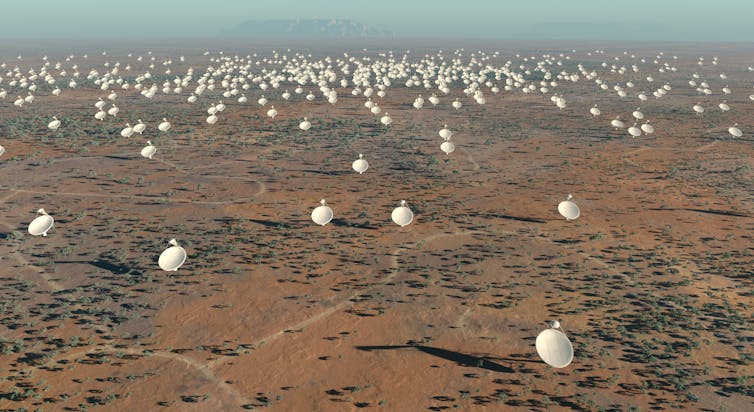
The largest telescope to ever be built – the Square Kilometre Array (SKA) – will measure the distribution of galaxies throughout the history of the universe. I’m planning to use the SKA to compare its observations to theoretical predictions for both a negative mass cosmology and the standard one – helping to ultimately prove whether negative masses exist in our reality.
The Square Kilometre Array may provide answers.SKA Project Development Office and Swinburne Astronomy Productions, CC BY-SA
What is clear is that this new theory generates a wealth of new questions. So as with all scientific discoveries, the adventure does not end here. In fact, the quest to understand the true nature of this beautiful, unified, and – perhaps polarised – universe has only just begun. Jamie Farnes, Research Associate & Astrophysicist based at Oxford's e-Research Centre, University of Oxford
According to new research from scientists at the NASA Ames Research Centre, spikes of ice known as penitentes
may tower
above the surface of Jupiter's moon Europa. Famous in the media in
recent years for its suspected subsurface saltwater ocean, this is a
prime location in the solar system for the search for extraterrestrial
life.
In the paper, scientists looked at the sublimation rates
of water ice across Europa's surface. By factoring other events that
might erode the icy moon's surface, such as asteroid impacts or
electrically charged particles hitting the moon from Jupiter, it was
found that this model would create a rough surface on Europa. In the
equatorial area of the moon, they found that sublimation would be
dominant enough to sculpt penitentes up to about 15 metres high and 7
metres across over a span of 50 million years (about the age of
Europea's surface)
These hypothesized areas of jagged ice
towers might pose a hazard for any future missions to Europa including
NASA's Europa lander concept. This will make reconnaissance key prior to deployal of any probes from orbit.
However it is just as possible that the penitente model may not apply to Europa. As it was based on penitente formation on Earth, some factors including a lack of atmosphere and Earth ices containing salts and sulfurous compounds could play a role in affecting this model.
"It is always pleasant to see how rigorous science can help us imagine
how the surface of an unknown planet could be at a scale never observed
yet," said planetary scientist Cyril Grima at the University of Texas at
Austin, who did not take part in this research.